
Share Abstract
Incidence and metabolomic signatures of preeclampsia in Zambian women
Abstract Content:
BACKGROUND: Preeclampsia (PE) represents a major pregnancy complication, accounting for approximately 14% of maternal deaths and between 10-25% of perinatal deaths globally. The exact biological pathway resulting in PE remain largely undefined. To answer this question and how HIV may alter these pathways, we performed a multi-omics analysis using longitudinally collected specimens from pregnant Zambian women.
METHODS: Plasma samples of 1,237 pregnant women without HIV and 1,105 women living with HIV collected throughout pregnancy (32 wks GA) were collected from a prospective antenatal cohort in Lusaka, Zambia and analyzed by Sapient for metabolomic signatures. To identify early biomarkers of PE, specimens were grouped by gestational age: <20 weeks GA versus 20 weeks GA. Metabolite detection and intensity were compared between all cases (PE) and non-cases and stratified by HIV status. Significance was determined as FDR<0.1. Enrichment and pathway analysis of significant metabolites was performed using MetaboAnalyst.
RESULTS: Plasma samples of 1,237 pregnant women without HIV and 1,105 women with HIV collected throughout pregnancy (32 wks GA) were collected from a prospective antenatal cohort in Lusaka, Zambia and analyzed by Sapient for metabolomic signatures. To identify early biomarkers of PE, specimens were grouped by gestational age: <20 weeks GA versus 20 weeks GA. Metabolite detection and intensity were compared between all cases (PE) and non-cases and stratified by HIV status. Significance was determined as FDR<0.1. Enrichment and pathway analysis of significant metabolites was performed using MetaboAnalyst.
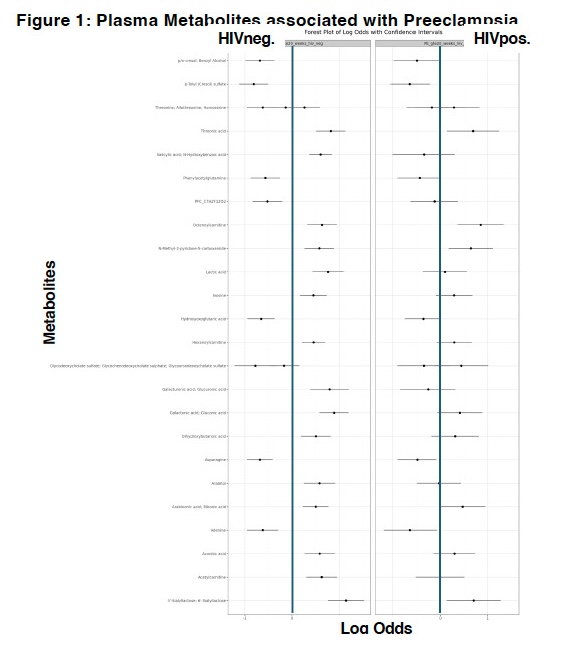
CONCLUSIONS: Women with PE exhibit differences in the plasma metabolome compared to women without PE. These metabolomic differences did not appear to be impacted by HIV status, despite the fact that PE was less frequent in women with HIV compared to women without HIV. Additional data of the plasma proteome are being analyzed to complement metabolome data and gain more conclusive insights into the mechanisms underlying PE.
METHODS: Plasma samples of 1,237 pregnant women without HIV and 1,105 women living with HIV collected throughout pregnancy (32 wks GA) were collected from a prospective antenatal cohort in Lusaka, Zambia and analyzed by Sapient for metabolomic signatures. To identify early biomarkers of PE, specimens were grouped by gestational age: <20 weeks GA versus 20 weeks GA. Metabolite detection and intensity were compared between all cases (PE) and non-cases and stratified by HIV status. Significance was determined as FDR<0.1. Enrichment and pathway analysis of significant metabolites was performed using MetaboAnalyst.
RESULTS: Plasma samples of 1,237 pregnant women without HIV and 1,105 women with HIV collected throughout pregnancy (32 wks GA) were collected from a prospective antenatal cohort in Lusaka, Zambia and analyzed by Sapient for metabolomic signatures. To identify early biomarkers of PE, specimens were grouped by gestational age: <20 weeks GA versus 20 weeks GA. Metabolite detection and intensity were compared between all cases (PE) and non-cases and stratified by HIV status. Significance was determined as FDR<0.1. Enrichment and pathway analysis of significant metabolites was performed using MetaboAnalyst.
CONCLUSIONS: Women with PE exhibit differences in the plasma metabolome compared to women without PE. These metabolomic differences did not appear to be impacted by HIV status, despite the fact that PE was less frequent in women with HIV compared to women without HIV. Additional data of the plasma proteome are being analyzed to complement metabolome data and gain more conclusive insights into the mechanisms underlying PE.